
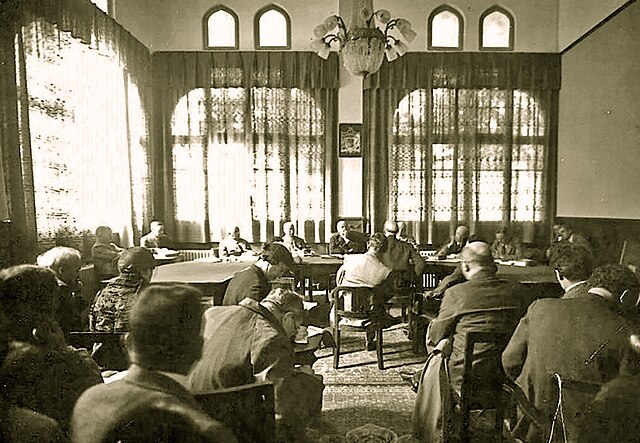
In 1936, a violent uprising erupted across Mandatory Palestine. Known as the Arab Revolt (1936–1939), its leaders framed it as a nationalist struggle against British colonialism and increasing Jewish immigration. But behind the rhetoric lay a more unsettling agenda, one that the British Peel Commission would later uncover when they met with the revolt’s spiritual and political leader, Haj Amin al-Husseini.
At the time, Jews made up about 30% of the population in Palestine. And despite being a minority, they were the target of widespread hostility. Arab militias attacked Jewish communities, ambushed convoys, and launched a general strike — not just against British governance, but against Jewish existence in the region.
The Peel Commission: Seeking Solutions, Finding Extremism
In response to the escalating violence, the British government formed the Peel Commission in 1937 to investigate the causes of unrest and propose a solution. The Commission’s findings were startling. After interviewing key Arab figures, including the Grand Mufti of Jerusalem, Haj Amin al-Husseini, they concluded that the root of the revolt was not economic inequality, colonial frustration, or border disputes.
It was rejectionism.
The Peel Commission concluded that the underlying causes of the Arab rebellion were — “the desire of the Arabs to prevent the establishment of the Jewish National Home in Palestine.”
When asked what would happen to the approximately 400,000 Jews already living in Palestine, the Mufti offered no clear assurances. The Peel Commission Report documented the Arab leadership’s refusal to accept any solution that involved a continued Jewish national presence. Elie Kedourie drew comparisons between the mood in Palestine and the 1933 Simele massacre in Iraq, where thousands of Assyrian Christians were slaughtered by state-backed forces.
The Peel Plan: Generosity Rejected
The Commission ultimately proposed the first two-state solution. In what would become known as the Peel Plan, the land would be divided into a Jewish state and an Arab state, with Jerusalem and surrounding areas remaining under British control.
Despite Jews comprising 30% of the population, the plan granted them 17% of the territory. The remaining 83% (the vast majority) was allotted to the Arabs. And even then, the plan included financial compensation and economic collaboration.
Still, al-Husseini rejected the plan outright, not because of borders, percentages, or sovereignty. He rejected it because it acknowledged any form of Jewish statehood or permanent Jewish presence in the land.
And if there were still any doubts about the uncompromising nature of the Arab leadership, their outright rejection of the 1939 White Paper, which drastically limited Jewish immigration and promised an Arab-majority state, proves that even total British concessions weren’t enough.
Not a Dispute Over Land — A Campaign of Erasure
It’s convenient today to frame the Arab Revolt and the broader conflict as a battle over land, colonialism, or Zionist aggression. But the Peel Commission, based on firsthand testimony and extensive inquiry, saw it differently:
“The Arab leaders have consistently refused to enter into any negotiations or discussions except on the basis that Palestine should forthwith become an Arab State.”
This becomes even clearer when we trace al-Husseini’s actions beyond Palestine. During World War II, he aligned himself with Nazi Germany, met with Adolf Hitler, and actively recruited Muslims into SS units. He also broadcasted Nazi propaganda across the Arab world and lobbied against Jewish refugees fleeing the Holocaust being allowed into Palestine.
Conclusion: Reckoning With the Truth
At what point do we recognize that no compromise would have ever satisfied the Arab leadership? No political agreement gives one side 100% of what they want. But this deal offered the Arab population the vast majority of the land, financial benefits, and their own independent state. Meanwhile, the proposed Jewish state, small and fractured, would likely have remained a democracy, one that history suggests would have welcomed peaceful Arab residents within its borders.
It’s time we stop whitewashing history. The events of 1937, and the testimony of the Peel Commission, make one thing painfully clear:
This was never just a dispute over land. It was a campaign against Jewish existence. And the man who led it later found his ideological match in Hitler.
Sources:
- Britannica – The Arab Revolt of 1936–39
- Peel Commission Report (1937) – British Government, Cmd. 5479
- Benny Morris, 1948: A History of the First Arab-Israeli War (2008)
- Efraim Karsh, Palestine Betrayed (2010)
- Jeffrey Herf, Nazi Propaganda for the Arab World (2009)
- Martin Gilbert, Churchill and the Jews: A Lifelong Friendship (2007)
- Elie Kedourie, “The Assyrian Minority in Iraq” – The Times Literary Supplement, 1933