
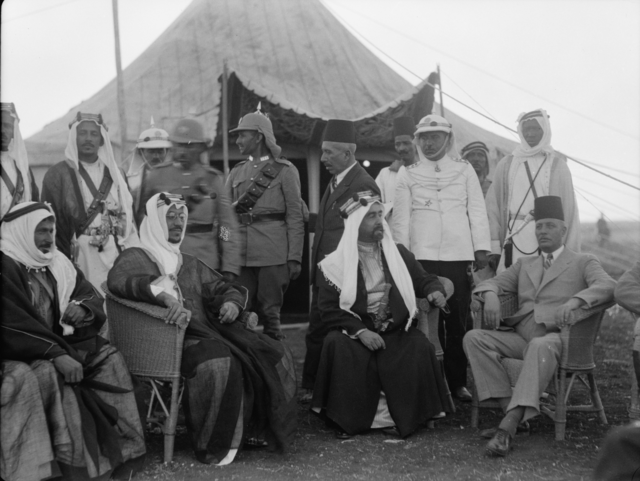
Long before Israel’s independence, partition was not just a Zionist idea, it was quietly embraced by some of the Arab world’s most senior statesmen.
In private meetings during the 1940s, prime ministers and kings from Iraq, Transjordan, and Egypt told British officials that dividing the land was the only just and realistic solution.
But they never said it aloud.
Fear of extremists, and the political violence that shadowed Arab politics, made it impossible for moderates to voice compromise publicly. The result was silence, rejectionism, and eventually, war.
Private Acceptance of Partition (1943–1946)
Iraq: Nuri al-Saʿid and Arshad al-Umari
In December 1944, Iraq’s veteran politician Nuri al-Saʿid told British officials that if partition were imposed, “there would be a necessity of removing the Arabs from the Jewish state.” He viewed it as the only way to achieve finality, and believed it “would not provoke a violent Arab reaction.”
Iraq’s foreign minister Arshad al-Umari agreed, repeating the same conclusion: “The necessity of removing the Arabs from the Jewish State.”
Transjordan and Egypt: Tawfiq Abul Huda & Mustafa Nahas Pasha
At meetings in 1943–44, Transjordan’s Prime Minister Tawfiq Abul Huda and Egypt’s Prime Minister Mustafa Nahas Pasha both admitted that “a final settlement can only be reached by means of partition.”
Abul Huda told the British High Commissioner outright that “he did not see any alternative.”
They recognized reality, but refused to say so publicly, knowing it would invite accusations of betrayal.
Transjordan’s King Abdullah and Ibrahim Pasha Hashim
By mid-1946, King Abdullah and his new prime minister Ibrahim Pasha Hashim echoed the same message. British Resident Alec Kirkbride recorded:
“The only just and permanent solution lay in absolute partition with an exchange of populations. Ibrahim Pasha admitted that he would not be able to express this idea in public for fear of being called a traitor.”
Abdullah believed other Arab leaders might quietly acquiesce to partition even if they publicly opposed it.
What This Reveals
- Partition Was Widely Understood as the Only Just Solution
Across Iraq, Transjordan, and Egypt, Arab officials privately agreed that coexistence required clear borders, and that partition was inevitable. - Moderates Were Trapped by Fear
The Arab world of the 1940s punished dissent harshly. Assassinations, coups, and intimidation silenced those who favored realism over absolutism. - Extremism Made Pragmatism Impossible
Every leader who voiced compromise in private refused to do so in public, fearing accusations of treason. That paralysis defined Arab politics through 1948 and beyond. - The Lesson of 1947 Still Echoes
The tragedy wasn’t that no one saw the solution, it’s that those who did were too afraid to defend it. The failure of 1947 was not ignorance, but fear.
Conclusion
Partition was not a foreign imposition or a Zionist trick. It was a widely recognized necessity, accepted behind closed doors by Arab leaders who saw no other path to peace.
But extremism ruled the public square.
Had these leaders spoken honestly, history might have unfolded very differently.
Their silence reminds us that peace requires more than ideas, it demands the courage to say them aloud.
Sources
- Benny Morris, The Birth of the Palestinian Refugee Problem Revisited, Cambridge University Press, 2004, pp. 140-144.
- British Colonial Office files: CO 733/455/2, CO 733/476/3, CO 537/1542.