
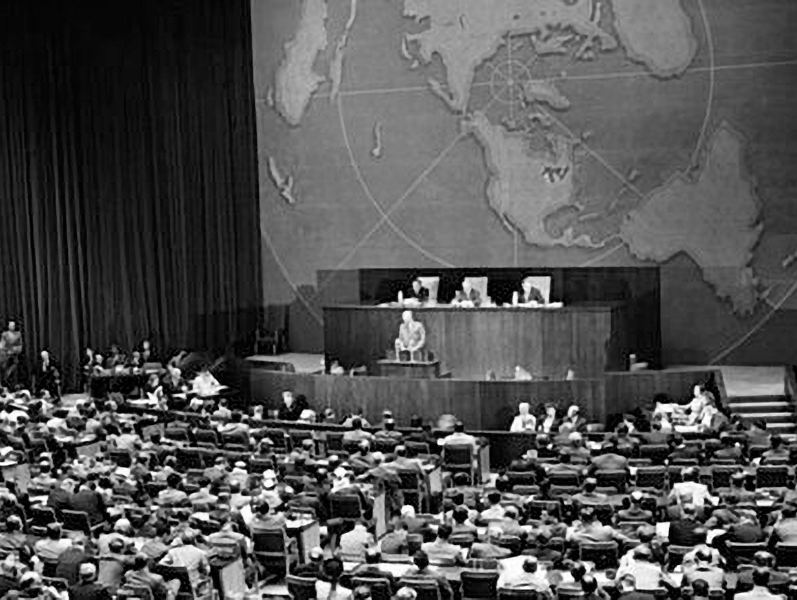
The UN’s framing of the 1947 Partition Plan reduces decades of Arab rejectionism to a single claim of “unfairness.” In reality, that rejection continued a long-standing refusal to accept any Jewish sovereignty, even under overwhelmingly favorable terms. From the Peel Commission (1937) to the British White Paper (1939), Jewish leaders repeatedly accepted painful compromises while Arab leadership met each with renewed violence.
Sentences 1 & 2
“In November 1947, the UN General Assembly passed a resolution partitioning Palestine into two states, one Jewish and one Arab, with Jerusalem under a UN administration. The Arab world rejected the plan, arguing that it was unfair and violated the UN Charter.”
Verdict: Misleading by omission
- The text omits that the Jewish leadership accepted the UN Partition Plan, even while expressing serious concerns about its borders and strategic viability.
- The Arab Higher Committee rejected the plan, not on fairness grounds but as part of a consistent refusal to allow any form of Jewish sovereignty.
- Even Arab moderates like Ibrahim Pasha Hashim (Prime Minister of Transjordan) acknowledged that partition was the only “just and permanent solution,” but admitted that extremists would “demand the impossible” and that moderates “could not say so publicly for fear of being called traitors.”
- The UN fails to mention the first partition proposal, the 1937 Peel Commission, which offered Jews just 17–20 percent of the land despite comprising nearly 30 percent of the population.
- The Jewish Agency accepted the recommendation; the Arab Higher Committee rejected it, triggering renewed violence.
(Sources: Peel Commission Report 1937; JCPA; PalQuest; British Archives.)
- The article also omits the 1939 British White Paper, which promised an independent Arab-majority state within ten years and severely limited Jewish immigration.
- Even with these pro-Arab concessions, Arab leaders rejected it, demanding immediate Arab sovereignty instead.
(Sources: history.state.gov; ECF; BJPA.)
These episodes show that the 1947 rejection was not about details, it was about denying any Jewish national home, regardless of the terms offered.
Sentence 3
“Jewish militias launched attacks against Palestinian villages, forcing thousands to flee.”
Verdict: False framing – reverses chronology and causality
- In reality, Arab forces launched the civil war immediately after the UN partition vote of November 29 1947, not Jewish militias.
- November 30 1947: Two Jewish passenger buses were ambushed; seven Jews were killed, and Arab snipers in Jaffa fired on passers-by in Tel Aviv.
- December 1: The Arab Higher Committee declared a three-day general strike, effectively mobilizing urban mobs for violence.
- December 2: Crowds attacked and looted the new Jewish commercial center in Jerusalem, setting fire to shops and assaulting Jewish civilians.
- As historian Benny Morris documents in The Birth of the Palestinian Refugee Problem Revisited (Cambridge University Press, 2004): “Strategically speaking, the period December 1947 – March 1948 was marked by Arab initiatives and attacks and Jewish defensiveness, increasingly punctuated by Jewish reprisals.”
- The record shows that Jewish defense organizations such as the Haganah initially adopted a reactive posture, focusing on convoy protection and civilian defense. Offensive operations (e.g., Plan D in April 1948) came months later, only after sustained Arab assaults on isolated Jewish communities and roads.
- November 30 1947: Two Jewish passenger buses were ambushed; seven Jews were killed, and Arab snipers in Jaffa fired on passers-by in Tel Aviv.
Thus, the UN article’s claim that “Jewish militias launched attacks” inverts cause and effect. The violence that displaced ‘Palestinians’ began with Arab-initiated hostilities, part of a broader pattern of anti-Jewish violence in the land, a pattern detailed in our UN Nakba Paragraph 1 assessment.
(Sources: Benny Morris, The Birth of the Palestinian Refugee Problem Revisited, Cambridge UP 2004, pp. 6–10; British Mandate Police Reports 1947–48; UN Special Committee on Palestine Records.)
Sentences 4 & 5
“The situation escalated into a full-blown war in 1948, with the end of the British Mandate and the departure of British forces, the declaration of independence of the State of Israel and the entry of neighbouring Arab armies. The newly established Israeli forces launched a major offensive.”
Verdict: Gross distortion of sequence and intent
- The UN text buries the invasion of five Arab armies under a neutral phrase — “the entry of neighbouring Arab armies” — and immediately reframes the next clause as an Israeli “major offensive.”
- In reality, the Arab invasion began on May 15, 1948, within hours of Israel’s declaration of independence, marking the transition from civil war to full-scale regional conflict.
- Egypt, Jordan (Transjordan), Syria, Lebanon, and Iraq simultaneously invaded the newborn state from all sides.
- Their declared objective was the destruction of the Jewish state, not limited military engagement. As the Arab League stated at the time, the goal was to liberate the land from Zionist occupation. (Arab League Statement, May 15, 1948; UN Security Council Records, S/PV.287, 1948.)
- Egypt, Jordan (Transjordan), Syria, Lebanon, and Iraq simultaneously invaded the newborn state from all sides.
- The Israeli “offensive” described by the UN was, in fact, a counter-offensive launched in defense of besieged territories after the initial Arab assault. Early Israeli operations, such as Operation Dani, Operation Dekel, and Operation Yoav, were aimed at breaking blockades, securing supply routes, and repelling invading forces.
- Historian Benny Morris notes that from May to July 1948, Israel’s survival hung in the balance. In the first weeks after the Arab invasion, the Jewish forces were outgunned and outnumbered, and their operations were largely defensive, aimed at halting Arab advances toward Tel Aviv and the coastal plain (Morris, 1948: A History of the First Arab–Israeli War, Yale University Press, 2008, pp. 181–200).
- The UN’s framing flattens this timeline, implying that Israeli offensives were acts of aggression rather than necessity, erasing the existential threat Israel faced when one-third of its population were Holocaust survivors and the neighboring powers had vowed to “drive the Jews into the sea.”
- Even British and UN officials at the time acknowledged that the invasion was a clear violation of international law and the UN Partition Plan. (UNSC Records, May–June 1948; British Foreign Office Memorandum No. 371/68389, June 1948.)
- The real “situation” was not an escalation between equals, it was a regional war of annihilation against a state less than a day old. To describe Israel’s response as a “major offensive” is not neutrality; it’s historical erasure disguised as balance.
Sentence 6
“The result of the war was the permanent displacement of more than half of the Palestinian population.”
Verdict: Misleading by omission – erases causality and context
- The Palestinian displacement was a direct consequence of the 1948 war, which was initiated by Arab forces following the rejection of the UN Partition Plan.
- Some expulsions did occur, but they were localized and wartime-based, not premeditated ethnic cleansing, a distinction that even anti-Zionist historians such as Avi Shlaim acknowledge.
- The outcome of the war mirrors a universal pattern in 20th-century conflicts: populations are displaced when wars are started and lost.
- For perspective, Germany lost roughly 25% of its pre-war territory and saw over 12 million ethnic Germans expelled from Eastern Europe after World War II, a consequence of aggression and defeat, not a unique injustice.
- Likewise, the Arab states that rejected partition and launched the war bore responsibility for its humanitarian fallout, including both Palestinian displacement and Jewish expulsion from Arab countries that followed.
(Sources: Benny Morris, The Birth of the Palestinian Refugee Problem Revisited, Cambridge UP 2004; Efraim Karsh, Palestine Betrayed, Yale UP 2010; R.J. Rummel, Statistics of Democide, 1997; UNRWA Archives.)
Sources
Sentence 1–2 Historical Context Sources
[1] United Nations, GA Resolution 181 (II) – Future Government of Palestine, 29 November 1947.
The resolution describes partition into separate Jewish and Arab states with Jerusalem under a special international regime. (UN text, see un.org/unispal document archives)
[2] PalQuest / UN Partition Plan summary
[3] Encyclopedia Britannica, “United Nations Resolution 181”
Notes Jewish community support and Arab rejection.
[4] Peel Commission (Palestine Royal Commission), Report of the Palestine Royal Commission (Cmd 5479, 1937).
Covers the first official British partition proposal, land allocations, and reactions.
[5] Wikipedia / secondary summary of the White Paper of 1939:
Describes its policies limiting immigration and land purchases, plus its rejection by Arab leadership under influence of al-Husseini.
[6] Benny Morris, The Road to Jerusalem: Glubb Pasha, Palestine and the Jews (2002), pp.
Shows policy shifts, Arab rejection, and commentary on partition proposals.
Sentence 3 Historical Context Sources
[1] Benny Morris, The Birth of the Palestinian Refugee Problem Revisited (Cambridge University Press, 2004), pp. 6–10, 58–60.
Morris lists early Arab ambushes, including the November 30 bus attack, and notes that organized Jewish offensive operations (e.g., Plan D) began only in April 1948 (p. 58).
[2] British Mandate Palestine Police Criminal Investigation Department (CID) Weekly Reports, December 1947 – January 1948, TNA (UK National Archives) file CO 733/456/4.
Contemporary police dispatches record the first post-UN-vote incidents: ambushes of Jewish buses near Lod (Nov 30), sniper fire from Jaffa into Tel Aviv, the Dec 1 Arab general strike, and the Dec 2 Jerusalem riots that destroyed Jewish businesses.
[3] United Nations Special Committee on ‘Palestine’ (UNSCOP) and UN Security Council Records, “Monthly Progress Report on the Situation in Palestine,” Dec 1947 – Mar 1948 (S/730, S/745).
UN field officers confirm that violence erupted immediately after the partition vote, identifying Arab armed bands and irregulars as the initial aggressors in late 1947.
[4] Yoav Gelber, Palestine 1948: War, Escape, and the Emergence of the Palestinian Refugee Problem (Brighton: Sussex Academic Press, 2001), pp. 41–53.
Chronology of the civil-war phase beginning Nov 30 1947; emphasizes Arab-initiated ambushes and Haganah’s defensive convoy escorts until spring 1948.
[5] Efraim Karsh, Palestine Betrayed (New Haven: Yale University Press, 2010), pp. 62–80.
Analyzes Mandate-era military reports showing that Jewish forces were largely reactive during the first months, with offensive plans formulated only after continuous Arab attacks on Jewish traffic and settlements.
[6] Benny Morris, 1948: A History of the First Arab–Israeli War (New Haven: Yale University Press, 2008), pp. 34–49.
Provides a complementary narrative: from the Nov 30 bus ambush through early 1948 reprisals, confirming that Arab irregulars and the Arab Higher Committee initiated hostilities before state-to-state war began.
Sentences 4 & 5 Historical Context Sources
[1] United Nations Security Council, Official Records, Third Year, No. 76 (S/PV.287), 15 May 1948.
Transcript of the urgent Security Council meeting held hours after Israel’s declaration of independence. Representatives of Egypt, Syria, Lebanon, Iraq, and Transjordan acknowledge that their forces entered Palestine that morning. The Egyptian delegate describes the invasion as “military action to restore order,” confirming that five Arab armies crossed the borders on 15 May 1948 (pp. 6–12).
[2] Arab League Statement, Cairo, 15 May 1948, reprinted in United Nations, Official Records of the Security Council, 3rd Year (S/745).
Declares the League’s intent “to restore the rights of the Arabs in Palestine and to liberate the country from Zionist occupation.” The communiqué leaves no ambiguity that the objective was elimination of the nascent Jewish state.
[3] Benny Morris, 1948: A History of the First Arab–Israeli War (New Haven: Yale University Press, 2008), pp. 181–200, 223–240.
Morris details the May–July 1948 campaign chronology: the initial Arab invasion on 15 May, the precarious Israeli defensive lines around Tel Aviv and Jerusalem, and subsequent Israeli counter-offensives (Operations Dani, Dekel, Yoav) aimed at relieving sieges and pushing back invading forces. He notes that Israel was outnumbered, and that the early fighting was “defensive in essence” (p. 181).
[4] David Tal, War in Palestine, 1948: Strategy and Diplomacy (London: Routledge, 2004), pp. 103–128.
Analyzes operational intent: Israeli offensives from July 1948 onward were reactive counter-campaigns designed to reopen supply corridors and repel invading armies.
[5] Michael Oren, Six Days of War: June 1967 and the Making of the Modern Middle East (Oxford: Oxford University Press, 2002), pp. 24–27.
Summarizes earlier war context: confirms five-front Arab invasion on 15 May 1948 and contemporary Arab rhetoric describing the campaign as one of “liberation” and “annihilation.”
[6] British Foreign Office Memorandum No. 371/68389, June 1948 (UK National Archives, FO 371/68389).
Describes the Arab invasion as “contrary to the spirit and letter of the United Nations Charter and the Palestine Partition Resolution” and warns that the stated Arab aim “can only be interpreted as the destruction of the Jewish State.”
[7] United Nations Security Council, Official Records, S/766 and S/801, May–June 1948.
Follow-up reports confirming that Egyptian and Transjordanian troops advanced deep into Israeli territory, including the siege of Jerusalem and attacks along Tel Aviv–Jerusalem road, while Israeli forces attempted to maintain supply lines and defend population centers.
[8] Chaim Herzog, The Arab–Israeli Wars: War and Peace in the Middle East from the War of Independence to Lebanon (New York: Vintage Books, 1984), pp. 51–67.
Provides a concise military overview, corroborating that early 1948 Israeli operations were reactive and that “the IDF’s first objective was survival, not expansion.”
Sentence 6 Historical Context Sources
[1] Benny Morris, The Birth of the Palestinian Refugee Problem Revisited (Cambridge University Press, 2004), pp. 589–592, 600–603.
Morris concludes that the majority of Palestinian flight occurred during combat operations and was precipitated by “the collapse of Arab social, political, and military structures” rather than pre-planned expulsion. He notes that while some localized expulsions took place, they “were not part of a master plan” (p. 592).
[2] Avi Shlaim, The Iron Wall: Israel and the Arab World (New York: W.W. Norton, 2014 rev. ed.), pp. 32–33.
Even as a revisionist historian, Shlaim acknowledges that “the refugee problem was born of war, not design,” and that Arab military intervention “turned what might have been a peaceful transition into a regional conflagration.”
[3] Efraim Karsh, Palestine Betrayed (New Haven: Yale University Press, 2010), pp. 210–238.
Analyzes refugee-movement case studies and concludes that “the exodus was a by-product of the Arab-initiated war,” emphasizing that Israeli operations were reactive to invasion and internal insurgency.
[4] United Nations Relief and Works Agency (UNRWA) Archives, Report of the Director (A/1451/Rev.1, 1950).
Early UNRWA statistics list approximately 726,000 registered Palestinian refugees—contextualized as displacement resulting from the 1948 Arab–Israeli War.
[5] R.J. Rummel, Statistics of Democide: Genocide and Mass Murder Since 1900 (New Brunswick: Transaction Publishers, 1997), pp. 320–324.
Provides comparative demographic data on wartime population transfers, including 12–14 million ethnic Germans expelled from Eastern Europe after WWII, illustrating the broader post-war pattern of displacement linked to aggression and defeat.
[6] Howard Sachar, A History of Israel: From the Rise of Zionism to Our Time (New York: Knopf, 2007 rev. ed.), pp. 323–340.
Describes reciprocal Jewish expulsions from Arab states (approx. 850,000 people between 1948 and 1970), noting that these events unfolded as a direct consequence of Arab governments’ retaliation following Israel’s independence.